Post-Quantum Cryptography

A conceptual illustration of Post-Quantum Cryptography featuring a quantum computer on one side and a digital security system on the other. In the center are cryptographic symbols such as keys, mathematical algorithms, and lattice structures. This image shows the transition from classical cryptography (RSA, ECC) to post-quantum algorithms (Kyber, Dilithium, FALCON, SPHINCS+) with a visualization of protecting sensitive data from quantum computing threats. The colors used are blue, purple, and green to reflect advanced technology and security.
Introduction
In the ever-evolving digital era, cybersecurity faces significant new challenges. The rapid development of quantum computing has created a real threat to the security infrastructure we rely on. Quantum computers, with their extraordinary parallel computing capabilities, have the potential to break traditional cryptographic algorithms that form the backbone of today's digital security.
Encryption systems like RSA and ECC (Elliptic Curve Cryptography), currently widely used to secure banking transactions, government communications, and other sensitive data, are based on mathematical problems that are difficult for conventional computers to solve. However, quantum computers have the ability to solve these problems in a much shorter time, leaving our security systems vulnerable.
This is why Post-Quantum Cryptography (PQC) is such an important topic to discuss. We need to develop security solutions that can survive the quantum computing era before the threat becomes a full-fledged reality.
What is Post-Quantum Cryptography?
Post-Quantum Cryptography (PQC) refers to cryptographic algorithms specifically designed to withstand attacks by quantum computers. Unlike classical cryptography, which relies on large prime factorization (RSA) or discrete logarithm (ECC) problems, PQC uses an alternative mathematical approach that even quantum computers struggle to crack.
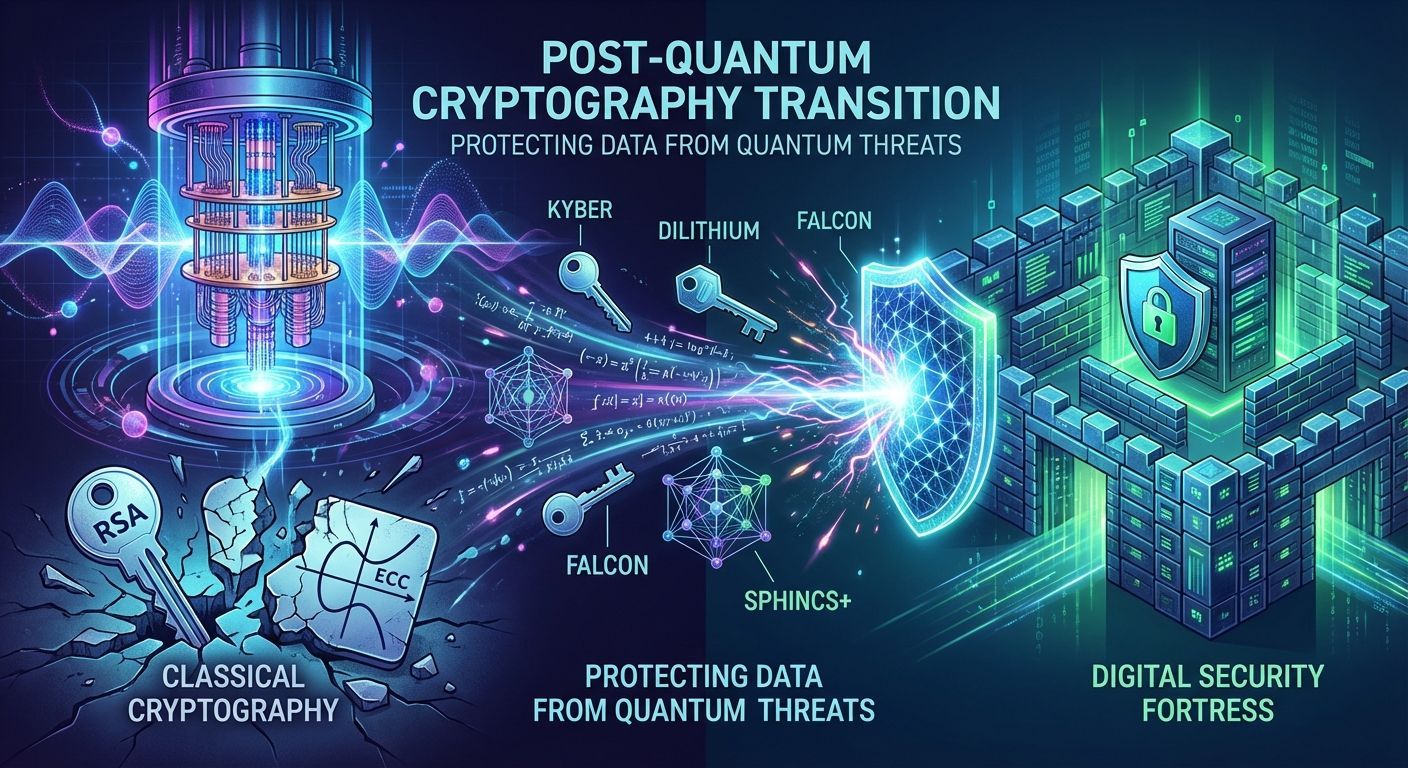
The fundamental difference between classical cryptography and PQC lies in their security assumptions. Classical cryptography relies on the computational difficulty of specific mathematical problems that can be efficiently solved by quantum algorithms like Shor's algorithm. Meanwhile, PQC is based on mathematical problems that remain difficult to solve even with the aid of quantum computers.
The primary goal of PQC is to ensure that data confidentiality and integrity are maintained even if an attacker has access to a powerful quantum computer. This is crucial for protecting sensitive information that needs to be kept secure long-term, such as state secrets, medical data, or financial information.
Threats from Quantum Computing
To understand the urgency of PQC, we need to understand how quantum computers threaten the security of current cryptography. One of the most famous quantum algorithms is Shor's Algorithm, developed by Peter Shor in 1994. It is capable of efficiently factoring large numbers—a problem that underpins the security of RSA.
In conventional systems, factoring the 2048-bit numbers used in RSA would take billions of years. However, with a suitable quantum computer, this process could be completed in hours or even minutes. Similarly, Grover's Algorithm can speed up searches in symmetric key spaces, though not as drastically as Shor's Algorithm.
Experts predict that quantum computers powerful enough to break 2048-bit RSA encryption may be available within the next 10-15 years. Several major technology companies, including IBM, Google, and Microsoft, have made significant progress in developing quantum computers, with Google claiming to have achieved "quantum supremacy" in 2019. While quantum computers are currently limited, their rapid development makes the threat to classical cryptography increasingly real.
Types of PQC Algorithms
Several major approaches have been developed to create cryptographic algorithms that are resistant to quantum attacks:
Lattice-based Cryptography
This approach is based on mathematical problems involving lattices in high-dimensional space. Algorithms like NTRU and Kyber use lattice structures to create cryptographic systems that are difficult to break even for quantum computers. Their main advantages are relatively high efficiency and strong security fundamentals, although key sizes tend to be larger than those of traditional systems.
Code-based Cryptography
Developed since 1978, this approach uses coding theory for security. The McEliece system is a famous example, having withstood over 40 years of cryptanalysis efforts. While highly secure, the large key size (several megabytes) presents a major implementation challenge.
Multivariate Polynomial Cryptography
This approach relies on the difficulty of solving a system of multivariable polynomial equations. This algorithm is generally very fast for signature verification, but it has a large key size, and some variants have been successfully cracked.
Hash-based Signatures
This method uses cryptographic hash functions to create a digital signature scheme. Examples include XMSS and SPHINCS+. Its advantage is very strong security under minimal assumptions, but its drawbacks are the large signature size and the limited number of signatures (for some schemes).
Each approach has trade-offs between security, efficiency, and key/signature size. There is no “one-size-fits-all” solution to PQC, and different applications may require different algorithms.
Standardization and Regulation
The United States National Institute of Standards and Technology (NIST) has led a global effort to standardize PQC algorithms since 2016. This process involved a thorough evaluation of algorithm designs submitted by researchers from around the world.
In July 2022, NIST announced the first algorithms selected for standardization: CRYSTALS-Kyber for public-key encryption and key establishment, and CRYSTALS-Dilithium, FALCON, and SPHINCS+ for digital signatures. The selection process for additional algorithms is ongoing.
This standardization has important implications for organizations in Asia. Multinational companies and government agencies need to prepare for the migration to this new standard to ensure global interoperability. Several Asian countries, such as Japan, South Korea, and Singapore, have begun developing guidelines and regulations related to PQC adoption, particularly for critical sectors like banking and telecommunications.
Real World Implementation
Migrating from traditional encryption systems to PQC presents significant technical and logistical challenges. Organizations need to identify all systems using cryptography, assess the risks, and develop a structured migration strategy. This process can take years for complex systems.
The most affected sectors include:
- Financial : Banks and financial institutions that manage transactions worth trillions of rupiah need to ensure long-term security.
- Health : Electronic medical records must remain secure for decades.
- Government : Confidential state documents and critical infrastructure require maximum protection.
A hybrid approach combining classical algorithms with PQC is becoming a popular transition solution. This approach allows organizations to maintain compatibility with legacy systems while gradually adding protection against quantum threats.
Challenges and Criticism
Despite its promise, PQC implementation faces several significant challenges:
PQC algorithms are generally more complex and require more computational resources than classical cryptography. This can be problematic for power-constrained devices such as IoT devices or smartphones.
Some PQC algorithms require specialized hardware for optimal performance, which means investing in new infrastructure. Software also needs to be extensively updated to support new algorithms.
There are risks in the timing of adoption: too soon means using algorithms that have not been fully tested, while too late could leave data vulnerable to “harvest now, decrypt later” attacks where data is harvested now to be decrypted later when quantum computers become available.
The Future of Quantum Security
In the next 5-10 years, we'll likely see widespread adoption of PQC. Global standards will mature, and implementations will become more efficient. Dedicated PQC hardware will likely become commonplace in data centers and consumer devices.
PQC will have a significant impact on other technologies:
- Blockchain : Cryptocurrencies and blockchain applications need to move to quantum-secure signatures to maintain security.
- IoT : Devices with limited resources require a lightweight yet secure PQC implementation.
- Cloud Computing : Cloud service providers need to ensure that customer data remains secure in long-term storage.
International collaboration in PQC research and development is crucial. Unlike the "crypto wars" of the past, security against quantum threats is a shared interest of all nations and organizations.
Conclusion
Post-Quantum Cryptography is not just a technical issue, but also a strategic challenge that requires the attention of policymakers, business leaders, and security professionals. While quantum computers capable of breaking modern encryption may still be years away, preparations must begin now given the complexity of migrating security systems.
We are at a crucial crossroads in the evolution of cybersecurity. With ongoing standardization and growing awareness, proactive measures taken now will determine the resilience of our digital infrastructure in the quantum era.
Organizations worldwide, including those in Asia, need to raise awareness about quantum quantum computing (PQC), begin assessing their vulnerabilities, and develop a roadmap for transitioning to quantum-safe algorithms. Only with thorough preparation can we ensure that the quantum revolution becomes an opportunity for technological advancement, not a security disaster.